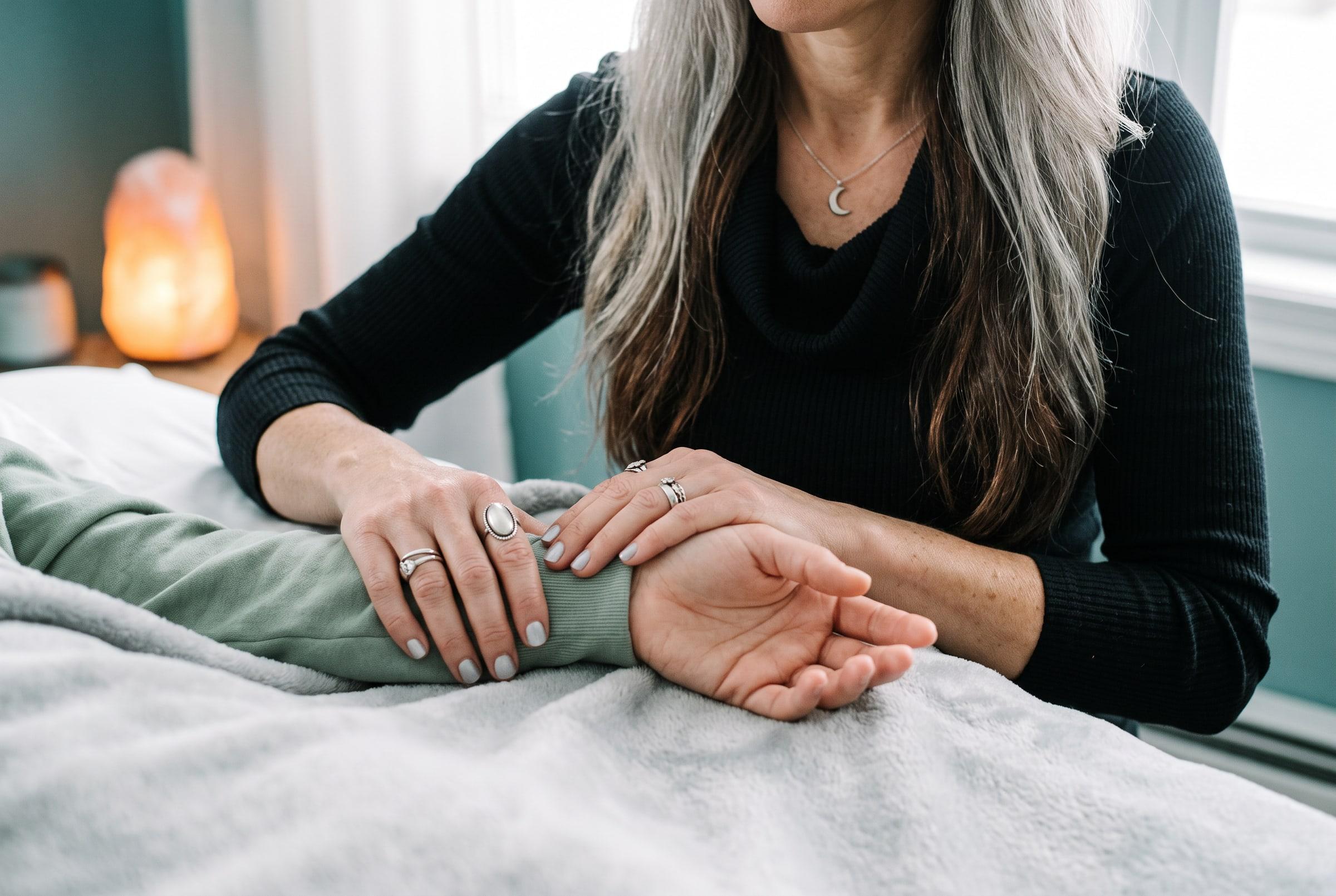
Biodynamic craniosacral therapy is a very gentle, hands-on practice in which the practitioner follows what your body is already doing instead of working it toward a plan. You stay fully clothed while hands rest still for long stretches, and most of the session is quiet. It differs from more structural styles of craniosacral work mainly in pace and intent: fewer moves, longer holds, and more listening than doing.
What does biodynamic mean?
In this context, biodynamic describes an approach rather than a technique. The practitioner rests their hands and waits, paying close attention, rather than applying a series of moves. The idea is to follow the body's own pace and let a session unfold, instead of steering it.
For you on the table, that mostly means stillness. The practitioner listens with her hands and lets your body guide where they rest, often for several minutes at a time. There is no kneading, pressing or cracking.
How is it different from other craniosacral therapy?
Craniosacral therapy is taught in more than one way. Some teachers sort the field into three broad approaches that all descend from the same cranial work: biomechanical, functional and biodynamic. Biomechanical styles follow a set protocol and use pressure or movement to address a specific condition. The biodynamic approach works the other way. It puts less weight on technique and more on stillness and attention, and the practitioner follows what your body is doing rather than steering it.
Soule Healing moved toward the biodynamic approach after years of practice. Jennifer Soule has been licensed in Indiana since 2009, began studying craniosacral therapy in 2017, and is trained in biodynamic craniosacral therapy with Giorgia Milne at the Touch of Presence® School for Biodynamic Studies (intensive, 2024 to 2025). The change shows up mostly in pace: sessions are quieter and slower than they used to be.
Where does the biodynamic approach come from?
Its roots are in osteopathy. Andrew Taylor Still founded the American School of Osteopathy in Kirksville, Missouri, in 1892, and the biodynamic field's North American association now also credits traditional Shawnee bodywork among those roots. William Garner Sutherland was a senior at that school in 1899 and spent the following decades developing cranial osteopathy. In the 1940s his work moved away from techniques and toward an approach that uses no force from outside the body.
Rollin Becker, an osteopath who studied with Sutherland, wrote of a "biodynamic potency" within the body, and later teachers took the name biodynamic from that phrase. From there the teaching has passed along more than one line. One runs through Franklyn Sills, who co-founded the Karuna Institute in England; his graduates began teaching in the United States in 1995, and the Biodynamic Craniosacral Therapy Association of North America formed in 1998. Another runs through the osteopath James Jealous, whom Jennifer's teacher, Giorgia Milne, names in the lineage she teaches. By the 1980s craniosacral training had opened to people outside osteopathy, which is how massage therapists like Jennifer came to study it.
What does a session feel like?
- You stay fully clothed, under a blanket if you like.
- The touch is very light and mostly still.
- Holds are long, sometimes several minutes.
- Many people notice warmth, heaviness or a settled quiet. Some drift close to sleep. Some notice very little at first.
- You can talk or stay silent, and you can ask for any hand placement to change or stop at any time.
What does research say about biodynamic craniosacral therapy?
Honestly, very little. Research on the biodynamic approach specifically is still very limited. Most clinical trials of craniosacral therapy used structural or unspecified methods, so their findings cannot be borrowed to describe the biodynamic approach.
Reviews of craniosacral therapy in general also disagree. A 2020 review of 10 randomized trials reported improvements in pain and function compared with a sham, while noting the small number and mixed quality of the studies. A 2024 review of 15 trials concluded that craniosacral therapy showed no benefits in the conditions it assessed. Both are worth reading. The fair summary is that the question is open.
Two things are more settled. Sessions are very gentle, and trials that tracked safety reported no serious adverse events. And in research interviews, people who chose craniosacral therapy described noticing changes across body, mind and spirit, and they valued the relationship with their practitioner.
For that reason, Soule Healing describes biodynamic craniosacral therapy as a gentle, deeply quiet practice rather than a medical treatment, and makes no claim that it changes any condition.
Who might enjoy it?
People come to Soule Healing for many reasons: stress that will not switch off, tension nobody could explain, an interest in quiet bodywork, or a wish for an hour where nothing is asked of them. People who dislike firm massage often appreciate how light the touch is. People who find stillness hard sometimes find it easier on the table than they expected.
How do I try it?
A biodynamic craniosacral session at Soule Healing is $100 for 60 minutes, at 201 E Main St in Madison, Indiana. Book online with no account and no password. You will not be charged when you book; pay at your session.
Craniosacral therapy complements, never replaces, medical care.
Frequently asked questions
- Where does biodynamic craniosacral therapy come from?
- From osteopathy. It grew out of William Garner Sutherland's cranial work, and its name comes from his student Rollin Becker, who wrote of a biodynamic potency within the body. It is now taught along more than one line, including one through the osteopath James Jealous, whom Jennifer's teacher names in her lineage.
- What is the difference between biodynamic and structural craniosacral therapy?
- Structural approaches work toward specific changes with more technique. The biodynamic approach follows what the body is already doing, with longer, stiller holds and a slower pace.
- Is there research on biodynamic craniosacral therapy?
- Very little. Research on the biodynamic approach specifically is still very limited, and reviews of craniosacral therapy in general disagree.
- Is biodynamic craniosacral therapy gentle?
- Yes. The touch is very light and mostly still. Trials of craniosacral therapy that tracked safety reported no serious adverse events.
Sources
- Craniosacral therapy for chronic pain: a systematic review and meta-analysis of randomized controlled trials. Haller H, et al. BMC Musculoskelet Disord, 2020. PMID 31892357 (opens in a new tab)
- Is Craniosacral Therapy Effective? A Systematic Review and Meta-Analysis. Ceballos-Laita L, et al. Healthcare (Basel), 2024. PMID 38540643 (opens in a new tab)
- Perspectives on the effects and mechanisms of craniosacral therapy: A qualitative study of users' views. Brough N, et al. Eur J Integr Med, 2015. doi 10.1016/j.eujim.2014.10.003 (opens in a new tab)
- Our Lineage Biodynamic Craniosacral Therapy Association of North America (opens in a new tab)
- The Evolution to Modern Biodynamic Craniosacral Therapy (BCST) Biodynamic Craniosacral Therapy Association of North America (opens in a new tab)
- Biodynamic Cranial Approach Giorgia Milne, Touch of Presence® School for Biodynamic Studies (opens in a new tab)