Forest bathing is slow, unhurried time among trees, and researchers have studied it for decades. Reviews of that research report short-term drops in self-reported stress and, in some studies, in body measures such as blood pressure and the stress hormone cortisol. The same reviews say plainly that most studies are small, that nobody can be blinded to being in a forest, and that the long-term picture is unknown. This article walks through what was measured, what was found, and where the evidence stops.
Where does forest bathing come from?
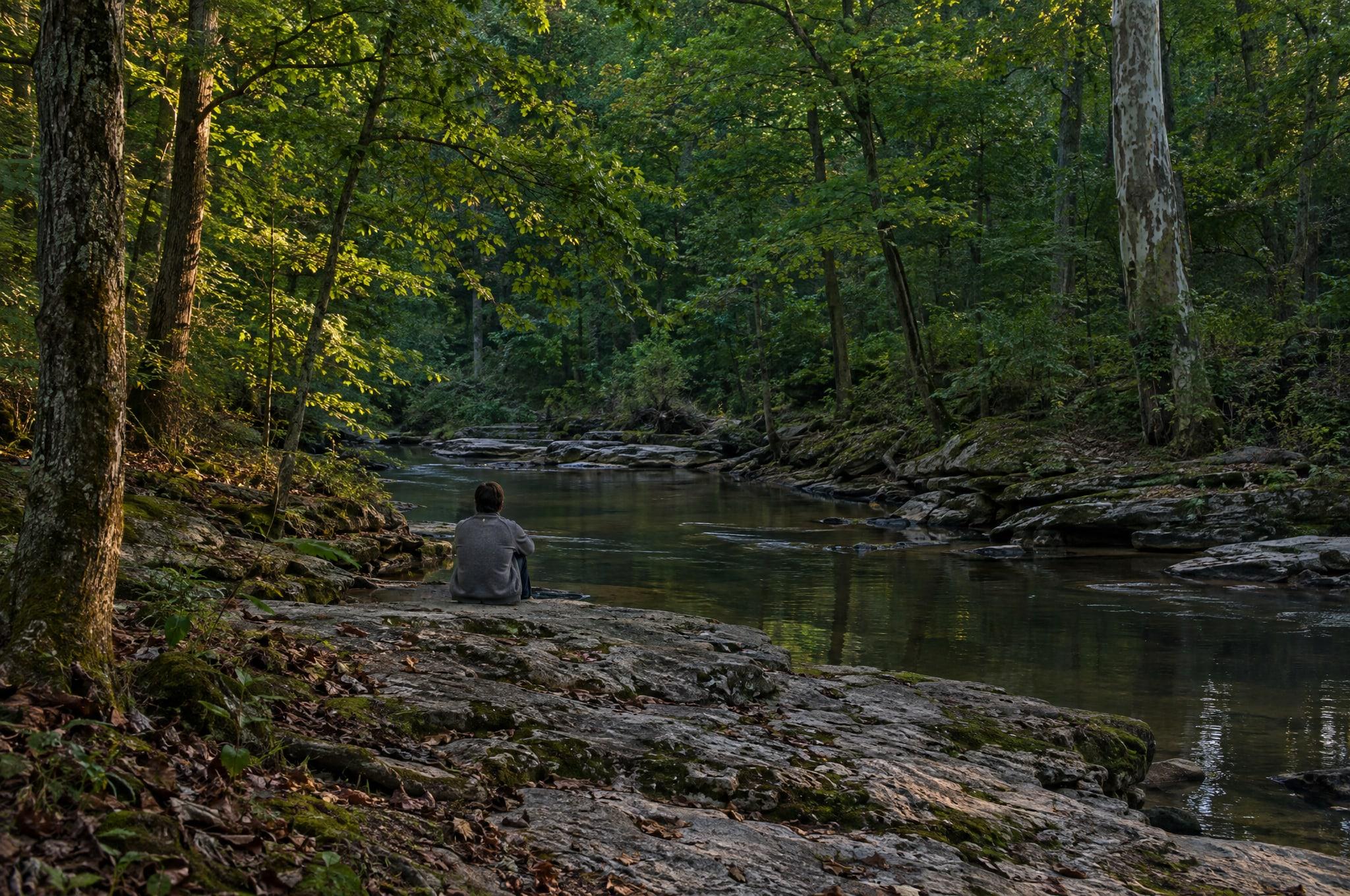
Shinrin-yoku, Japanese for "forest bathing," was introduced by Japan's forest agency in 1982. The idea was simple: spend relaxed time in a forest and take in its atmosphere through all the senses. It is not exercise and it is not a hike. People walk slowly, pause often, and pay attention to what they can see, hear, smell and touch.
Much of the early research was done in Japan. In one large set of field experiments, researchers took young men to 24 forests across the country and compared short walks and quiet sitting in each forest with the same activities in a city. The walks lasted about 16 minutes. In the forests, the men had lower cortisol, a lower pulse and lower blood pressure than in the cities. Those participants were healthy university students on short visits, which is worth remembering whenever a headline promises more.
What do the big reviews find about blood pressure and stress hormones?
A 2017 meta-analysis pooled 20 trials with 732 participants and found that systolic blood pressure averaged about 3 mmHg lower in forest settings than in non-forest settings. The authors note that most of the trials measured effects right after the visit, so the review could say nothing about the long term.
A 2019 review of cortisol studies found forest bathing was associated with short-term reductions in cortisol, a stress hormone. Its authors warn that expectation can play a part: people know when they are in a forest, and they may expect to feel better there.
A 2022 meta-analysis of studies in city residents found lower blood pressure and cortisol after forest programs than in city comparison groups, with larger effects for programs of 20 minutes or more. It also found large differences from study to study, which makes any single number uncertain.
Not every review agrees. A 2022 review limited to randomized trials, the most careful kind of study, found no significant effect on blood pressure, although it did find lower depression scores. That is a useful check on the more hopeful findings.
What about mood, stress and anxiety?
Most newer research asks people how they feel before and after time in a forest. Several reviews published from 2021 to 2026 report reductions in self-reported stress, anxiety and depression after forest therapy. They also caution that studies vary widely, that many come from a handful of countries, and that participants cannot be blinded. A 2026 meta-analysis of 25 studies rated the certainty of its findings as moderate for stress and low for emotional symptoms.
A second 2026 review, of 18 randomized trials, found reductions in depressive symptoms, with guided and self-guided sessions showing similar results. The authors call the certainty limited. That finding is worth sitting with if you are deciding whether to join a guided walk: the research does not show that a guide makes time in the forest work better. What a guide offers is structure, a slower pace and company, which some people want and others do not.
Session length may matter. A 2025 analysis of mood studies found that longer sessions, an hour or more, were associated with larger mood benefits than shorter ones.
What about the immune system studies?
You may have read that forest bathing affects the immune system. That idea traces mainly to a series of small Japanese studies by the researcher Qing Li. In small Japanese studies of about a dozen men each, a three-day forest trip was followed by higher activity of natural killer cells, a type of immune cell. In a follow-up, the change lasted at least a week and did not appear after a comparable city trip.
Those studies are interesting, and they are also tiny, almost entirely men, and without the controls that would allow firm conclusions. Soule Healing makes no claim that guided forest walks do anything for your immune system, and it is reasonable to be wary of anyone who does.
What happened when US researchers studied guided walks?
The most useful study for an American reader may be the least flattering. In a 2022 randomized trial, physicians and other healthcare workers took one three-hour guided walk. Their burnout scores did not change measurably compared with a control group, although participants overwhelmingly reported feeling less stressed. One walk did not change something as entrenched as burnout, and the researchers said so.
Smaller US studies are encouraging and limited. In a pilot with 15 medical residents, more participants reported feeling calm after a guided walk than before it. A small study of teenagers found well-being scores rose after a series of guided walks, and a second paper from the same researchers explored the same group. Physicians in a Boston pilot rated guided forest therapy as highly valuable. An early, uncontrolled study followed veterans through a one-hour guided walk in a Midwestern forest. None of these had a strong control group, and together they involve few people.
So how strong is the evidence overall?
A 2021 umbrella review looked across 11 systematic reviews covering 131 studies. Those reviews reported benefits, but confidence in most of them was rated low or critically low. Earlier overviews, including a 2017 review of 64 studies, say the same thing in different words: the findings point in a fairly consistent direction, and the field needs larger, longer and better-controlled studies.
Put together, the research supports a modest and honest summary:
- Supported, with caveats: short-term drops in self-reported stress, and in some studies lower blood pressure and cortisol during or right after time in a forest.
- Mixed: whether those changes last, and whether they hold up when only randomized trials are counted.
- Not shown: that a guided walk works better than time in the woods on your own.
- Not shown: any effect on disease. Forest bathing is a way to spend time, not a medical intervention.
Why does a craniosacral therapist care about forest bathing?
Bodywork and forest bathing share a pace: slow, quiet and attentive to small sensations. Researchers who write for bodywork practitioners have started to notice forest bathing too. A 2023 review written for that audience gathered 13 studies on forest bathing and depression and rated their quality as poor. That is not evidence for anything Soule Healing offers. It is a sign that people who work with touch are paying attention to time outdoors, and that is why Jennifer Soule became a forest therapy guide through ANFT.
What does this mean if you want to try it?
Go in with an open mind and an open heart. A walk is a chance to slow down and notice, and the research suggests many people feel calmer for it. It does not promise more than that. If you would like company and a gentle structure, a guided walk offers both. If you would rather go alone, a quiet hour on a local trail is a fine place to start.
Soule Healing's guided walks last about two and a half hours and cover well under a mile at a slow pace. They are led by a certified forest therapy guide with the Association of Nature and Forest Therapy (ANFT).
Forest bathing is a wellness practice, not a medical treatment; it complements, and never replaces, care from your doctor.
Frequently asked questions
- Is there good evidence for forest bathing?
- There is a growing body of research, mostly small studies. Reviews report short-term drops in self-reported stress and in some body measures, and they rate the overall certainty as low to moderate.
- Do I need a guide to forest bathe?
- You don't necessarily need a guide to forest bathe. But having a guide can create a sense of safety. A guide also creates a gentle, intentional space for participants to slow down, reconnect with their senses and experience nature in a way that supports overall well-being. Being led by a guide trained through ANFT, there is a standard sequence that the guide follows that has been known to really deepen a participant's experience.
- How long should a session be?
- A 2025 analysis of mood studies found that sessions of an hour or more were associated with larger mood benefits than shorter ones.
- Does forest bathing affect the immune system?
- Small Japanese studies found higher activity of natural killer cells, a type of immune cell, after forest trips. They are too small to support a health claim, and Soule Healing makes none.
Sources
- Trends in research related to "Shinrin-yoku" (taking in the forest atmosphere or forest bathing) in Japan. Tsunetsugu Y, Park BJ, Miyazaki Y. Environ Health Prev Med, 2010. PMID 19585091 (opens in a new tab)
- The physiological effects of Shinrin-yoku (taking in the forest atmosphere or forest bathing): evidence from field experiments in 24 forests across Japan. Park BJ, et al. Environ Health Prev Med, 2010. PMID 19568835 (opens in a new tab)
- Blood pressure-lowering effect of Shinrin-yoku (Forest bathing): a systematic review and meta-analysis. Ideno Y, et al. BMC Complement Altern Med, 2017. PMID 28814305 (opens in a new tab)
- Effects of forest bathing (shinrin-yoku) on levels of cortisol as a stress biomarker: a systematic review and meta-analysis. Antonelli M, Barbieri G, Donelli D. Int J Biometeorol, 2019. PMID 31001682 (opens in a new tab)
- The Effects of Forest Therapy on the Blood Pressure and Salivary Cortisol Levels of Urban Residents: A Meta-Analysis. Qiu Q, et al. Int J Environ Res Public Health, 2022. PMID 36612777 (opens in a new tab)
- Does Forest Therapy Have Physio-Psychological Benefits? A Systematic Review and Meta-Analysis of Randomized Controlled Trials. Yi Y, Seo E, An J. Int J Environ Res Public Health, 2022. PMID 36078228 (opens in a new tab)
- Effect of Forest Therapy on Depression and Anxiety: A Systematic Review and Meta-Analysis. Yeon PS, et al. Int J Environ Res Public Health, 2021. PMID 34886407 (opens in a new tab)
- Effects of Shinrin-Yoku (Forest Bathing) and Nature Therapy on Mental Health: a Systematic Review and Meta-analysis. Kotera Y, Richardson M, Sheffield D. Int J Ment Health Addict, 2022. doi 10.1007/s11469-020-00363-4 (opens in a new tab)
- The effects of forest bathing on psychological well-being: A systematic review and meta-analysis. Siah CJR, et al. Int J Ment Health Nurs, 2023. PMID 36864583 (opens in a new tab)
- Forest therapy for psychological stress and emotional disorders: a systematic review and meta-analysis. Qin G, et al. BMC Public Health, 2026. PMID 41998562 (opens in a new tab)
- Effects of Forest Therapy on Depressive Symptoms: A Systematic Review and Meta-Analysis. Lu K, et al. Psychol Res Behav Manag, 2026. PMID 42668994 (opens in a new tab)
- Benefits of forest therapy for adult mental health: a systematic review and meta-analysis based on the Profile of Mood States (POMS). Shang X, et al. Front Psychol, 2025. PMID 41256089 (opens in a new tab)
- Forest bathing enhances human natural killer activity and expression of anti-cancer proteins. Li Q, et al. Int J Immunopathol Pharmacol, 2007. PMID 17903349 (opens in a new tab)
- Visiting a forest, but not a city, increases human natural killer activity and expression of anti-cancer proteins. Li Q, et al. Int J Immunopathol Pharmacol, 2008. PMID 18336737 (opens in a new tab)
- Assessing the Impact of a Shinrin-Yoku (Forest Bathing) Intervention on Physician/Healthcare Professional Burnout: A Randomized, Controlled Trial. Kavanaugh J, et al. Int J Environ Res Public Health, 2022. PMID 36361384 (opens in a new tab)
- Morrison KT, et al. A guided nature and forest therapy walk for internal medicine residents, brief report. Glob Adv Integr Med Health, 2024. PMID 38250708 (opens in a new tab)
- Forest Bathing Increases Adolescents' Mental Well-Being: A Mixed-Methods Study. Keller J, et al. Int J Environ Res Public Health, 2023. PMID 38276796 (opens in a new tab)
- Keller J, et al. Ecopsychology, 2024. doi 10.1089/eco.2023.0070 (opens in a new tab)
- Supporting Wellness, Resilience, and Community With Forest Therapy. Abookire SA, Ayala SG, Shadick NA. Glob Adv Integr Med Health, 2024. PMID 38601344 (opens in a new tab)
- Gil, et al. An early, uncontrolled study of a guided forest therapy walk with veterans. J Veterans Studies, 2025. doi 10.21061/jvs.v11i2.746 (opens in a new tab)
- Stier-Jarmer M, et al. Umbrella review of systematic reviews on forests and health. Int J Environ Res Public Health, 2021. PMID 33670337 (opens in a new tab)
- Shinrin-Yoku (Forest Bathing) and Nature Therapy: A State-of-the-Art Review. Hansen MM, Jones R, Tocchini K. Int J Environ Res Public Health, 2017. PMID 28788101 (opens in a new tab)
- Doran-Sherlock R, et al. Integrative review of forest bathing and depression for bodywork practitioners. J Bodyw Mov Ther, 2023. PMID 37330777 (opens in a new tab)