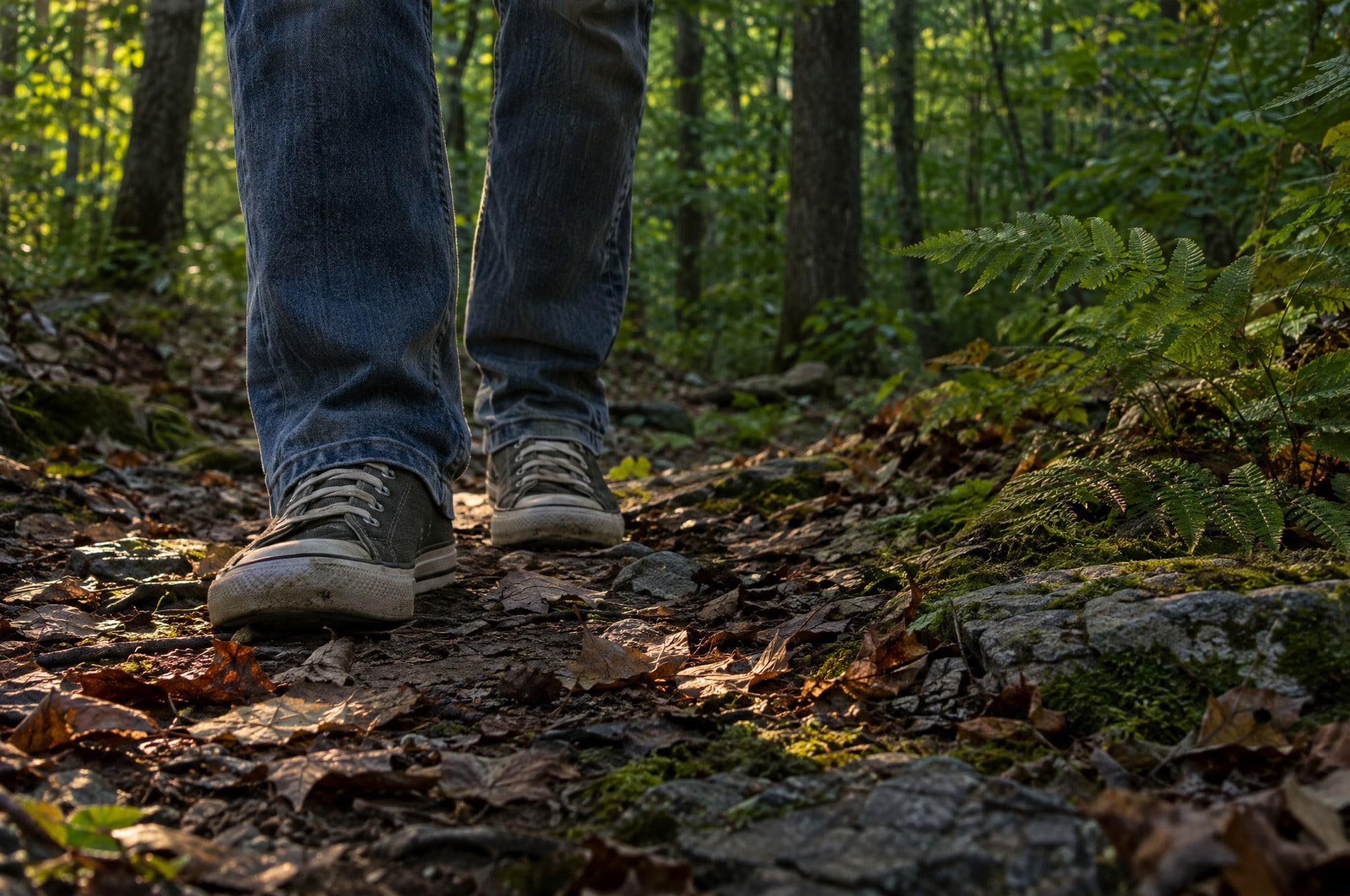
Forest bathing is slow, unhurried time in the woods, spent noticing rather than going somewhere. For a beginner, it asks for nothing more than comfortable shoes and a willingness to slow down. You do not need to be fit, outdoorsy or good at meditating. A guided walk covers a short distance over a couple of hours, with pauses, simple invitations to notice, and a cup of tea at the end.
What is forest bathing, exactly?
Shinrin-yoku, Japanese for "forest bathing," was introduced by Japan's forest agency in 1982. The name sounds odd in English. There is no water involved. "Bathing" means immersing yourself in the atmosphere of the forest through your senses: the smell of the leaves, the sound of the wind, the feel of bark or moss under your hand.
Forest therapy is the name often used for guided forest bathing. A guide sets a slow pace and offers invitations, small suggestions about what to notice, and you take each one up in your own way.
Is forest bathing a hike?
No. This is the most common surprise for beginners. A hike is about distance, pace and getting somewhere. Forest bathing is the opposite. On Soule Healing's introductory walks you cover well under a mile in about two and a half hours. Much of that time is spent standing, sitting or wandering slowly.
Because of that, it suits people who would never call themselves outdoorsy. If you can walk slowly on an unpaved path and sit for a while, you can forest bathe.
What happens on a first guided walk?
Every walk follows the same simple shape:
- Arrival and threshold: the group gathers, introductions are short, and you step from the busy day into slower time.
- Invitations: a slow wander with small prompts to notice what is moving, what you can hear and what is under your feet.
- Sit spot: you find a spot and sit or stand quietly on your own, within sight of the group.
- Sharing circle: anyone who wants to can say what they noticed. Sharing is always optional.
- Closing tea: a simple herbal tea to close the walk, with thanks to the place.
What should a beginner wear and bring?
Layers, closed-toe shoes, a water bottle and a rain layer; in winter add a sit pad and a warm drink. Dress for standing still as much as walking: you will feel cooler than you would on a brisk hike.
Do I have to talk?
No. Every invitation is optional, and so is speaking in the sharing circle. Many people stay quiet the whole time. A guide never asks you to explain yourself.
What if I find it hard to slow down?
Most beginners do, at first. Your mind may race, you may feel self-conscious, or you may wonder if you are doing it right. There is no right way. Those feelings usually soften as the walk goes on. The invitations give your attention somewhere to land, and the slower pace does much of the rest.
What does research say?
Reviews of forest bathing research report short-term drops in self-reported stress, and some studies found lower blood pressure and cortisol in forest settings. Most studies are small, and a 2026 review found guided and self-guided time worked about the same, so a guide is a choice, not a requirement.
Forest bathing is a wellness practice, not a medical treatment; it complements, and never replaces, care from your doctor.
Where can I try forest bathing near Madison, Indiana?
Soule Healing leads introductory walks on the Heritage Trail of Madison, along its unpaved side paths. Groups are small, up to 10 people. Walks are led by a certified forest therapy guide with the Association of Nature and Forest Therapy (ANFT). The price is announced with the first dates.
Frequently asked questions
- Is forest bathing hard?
- No. You cover well under a mile in about two and a half hours, at a slow pace with long pauses.
- Do I need experience to forest bathe?
- No. Forest bathing asks only for comfortable shoes and a willingness to slow down.
- What if it rains?
- Walks go ahead in light rain. In storms, high wind or ice the walk is rescheduled, and you hear from us by email the day before.
- Do I have to share in the circle?
- No. Sharing is always optional.
Sources
- Trends in research related to "Shinrin-yoku" (taking in the forest atmosphere or forest bathing) in Japan. Tsunetsugu Y, Park BJ, Miyazaki Y. Environ Health Prev Med, 2010. PMID 19585091 (opens in a new tab)
- Effects of Forest Therapy on Depressive Symptoms: A Systematic Review and Meta-Analysis. Lu K, et al. Psychol Res Behav Manag, 2026. PMID 42668994 (opens in a new tab)